A bag marked 85% extraction offers a baker a clue, but not a recipe. The figure begins at the mill. It says how much flour was recovered from a given weight of wheat under that mill's stated method. It does not say that the flour is 85% protein, 85% whole grain, or 85% as strong as another bag. Those are different questions, asked of different parts of the process.
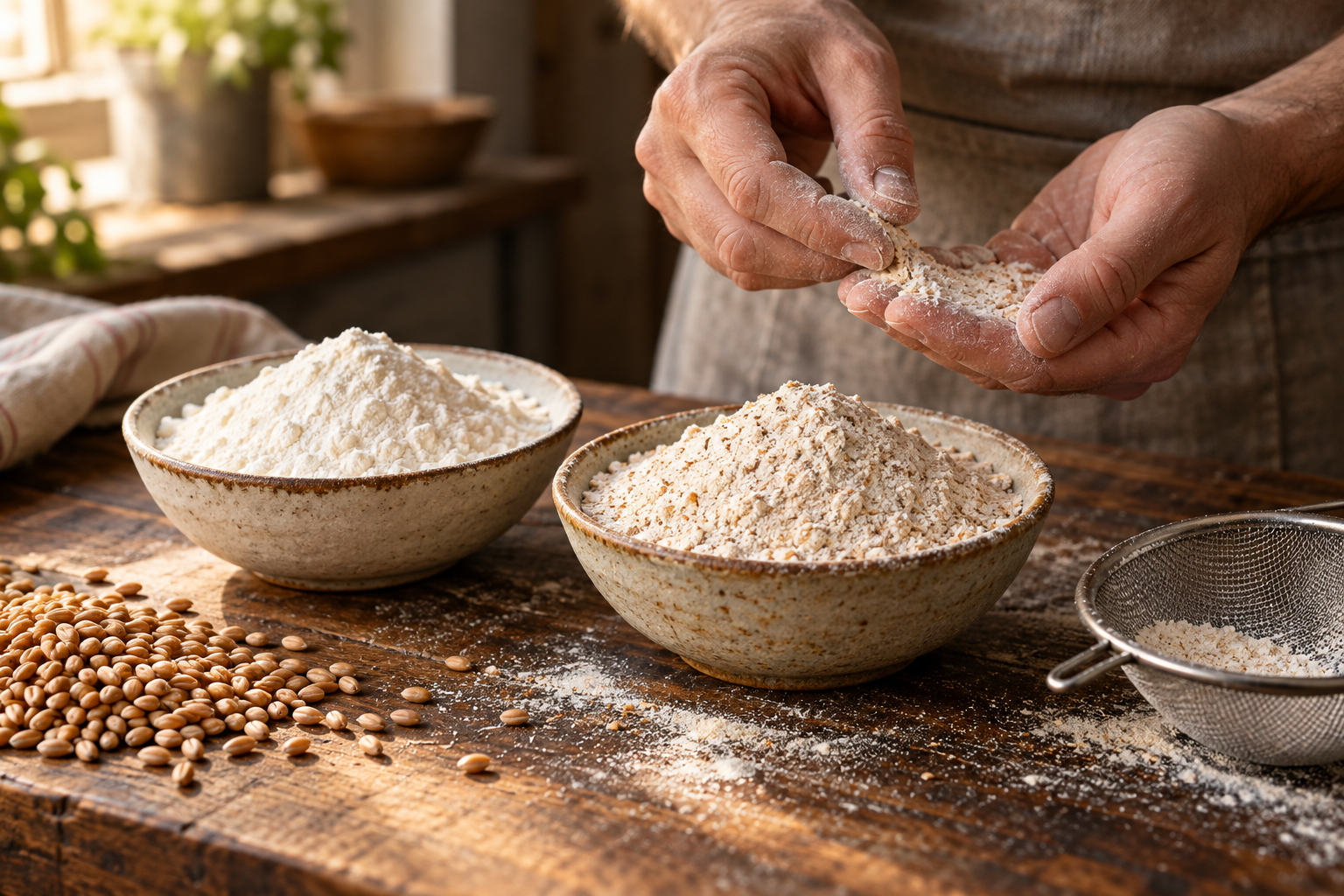
To see what the number can tell us, start with the wheat rather than the dough. A kernel has a starchy endosperm, surrounding layers commonly gathered as bran, and a germ. In roller milling, cleaned and conditioned wheat passes through successive breaks, reductions and sieves. The mill collects several flour streams and can blend them in different proportions. At the Canadian Grain Commission's laboratory, technicians deliberately combine streams to a fixed yield so that wheat lines can be compared fairly. Its published milling procedure expresses flour yield as a percentage of clean wheat on a constant moisture basis. That last condition matters: grain and flour absorb water, so two weights taken at different moisture levels are not a clean comparison.
An 80% extraction rate, in this sense, means roughly 80 units of flour from 100 units of wheat on the specified basis. It is a recovery figure. It is not a statement that 20% of the grain was simply thrown away; separated material can become other mill products. Nor is the figure identical to the proportion of bran in the bag. Which streams went into that 80 units matters as much as the arithmetic.
The useful direction of the number
Within one wheat lot and milling setup, raising extraction commonly draws in more material from nearer the grain's outer layers. Such flour may be darker and carry more ash, fiber and water-binding material. The direction is visible in controlled baking research. In a 2023 experiment with one Cham-4 wheat, flours milled to 70, 75 and 80% extraction differed in ash, protein, crude fiber, color and dough tests. As extraction rose, farinograph water absorption rose too, while dough stability fell. That is a finding for those flours and that flatbread method, not a fixed law telling every baker how many extra grams of water to add.
A separate commercial-scale tortilla study compared hard white and hard red winter wheat flours at 74, 80 and 100% extraction. Within the tested series, protein, ash and water absorption increased with extraction. The two wheat types still differed from each other in protein and dough strength. The 100% extraction tortillas were acceptable to the study's panel, while the 74 and 80% versions had the best measured firmness and rollability. Even a clear trend in flour composition did not produce a single ranking for every finished product.
For a baker, this makes extraction a sensible first warning about dough behavior. A flour made with more peripheral grain material may take up water differently and need a different mixing or resting approach. It may bring a fuller grain flavor or a darker crumb. But extraction alone cannot tell whether the dough will be supple, tight or fragile. The recipe, the wheat and the mill's treatment of each fraction still have their say.
Why ash is a different number
Millers often report ash alongside extraction. Ash is the residue left after a flour sample is burned under a defined laboratory method; it is used as a measure of mineral content. Outer parts of wheat are richer in mineral material than the central endosperm, so ash often rises as more outer streams enter a flour. That makes it useful, but it is a chemical measurement rather than a count of how much wheat became flour.
The Canadian Grain Commission holds extraction constant at 74% when testing advanced wheat lines. At the same yield, a line with lower flour ash may let a commercial mill recover more flour while meeting an ash specification. If ash and extraction were interchangeable, there would be no reason to hold one still while measuring the other. Its laboratory account also shows how tempering changes both yield and ash: wheat that is too dry lets more bran grind fine, while wheat that is too wet leaves more endosperm clinging to bran.
The relationship can be less intuitive when the mill changes its route through the kernel. In a 2022 debranning experiment, researchers abraded outer wheat layers before milling. The resulting flour grew lighter in color while its ash rose, which the authors attributed to more mineral-rich aleurone entering the flour. Light color, low ash and low extraction are therefore related clues under familiar milling conditions, not three names for the same fact. The study examined particular wheats and settings; it does not mean debranning always has that result.
Protein is not a verdict on dough strength
The protein percentage on a flour specification has its own limits. Some proteins from the outer kernel do not contribute to a continuous gluten network in the way a baker needs for a lofty loaf. More extracted material can raise measured total protein while changing how the dough stretches, holds gas or tolerates mixing. The Cham-4 flatbread study found higher extraction alongside changes in protein and gluten tests, yet lower dough stability and alveograph measures. A baker who reads only the rising protein figure could expect the opposite handling behavior from the one measured in that trial. The experiment is especially useful because the wheat was held constant while extraction changed.
There is another limit at the whole-grain end. A flour made by milling the whole kernel, or by recombining all its fractions in their original proportions, can be described as wholemeal. That still leaves room for different particle shapes and sizes. In a 2020 experiment with three wheat varieties, researchers produced wholewheat flours using cyclonic, hammer and roller mills. For the roller-milled samples, they collected and recombined every stream so the bran, germ and endosperm proportions matched the original grain. Yet the milling method changed water absorption, dough development and bread volume in their small test loaves. The same retained fraction of a kernel did not mean the same dough.
The practical lesson is to treat a new extraction rate as a reason to observe. Begin with the flour's actual water absorption and how the dough develops, rather than importing a universal hydration rule from a label. Let the dough take up water before judging its feel; adjust mixing and proofing to what it does. In a 2023 bakery trial of wholemeal, refined roller-milled and stone-ground flours, the authors found that sourdough conditions had to be tailored to the flour to improve bread quality. Because flour type and milling method both changed in that comparison, it is evidence for tuning the process, not proof that extraction by itself caused every difference.
The nutrition question belongs to the flour
Higher extraction can retain more of the parts of wheat that carry fiber and minerals. That is a sound reason to care about the number, but it is not a nutritional score for the loaf. Which streams were included, the wheat grown, and the rest of the recipe determine what a person eats. The bakery trial measured higher phytic acid in its wholemeal flour than in the more refined flours. Phytate can reduce mineral availability, so a higher mineral content cannot by itself specify how much mineral the body will absorb. The researchers' flour analyses make that distinction visible without turning one bread test into a health claim.
Extraction is most valuable when read with neighboring facts: wheat type, protein and dough tests, ash, particle size, and the bread being made. The number tells a baker how far the mill carried its recovery of the grain. It invites a question about what entered the flour, then leaves the flour and dough to answer the rest.

A thought worth keeping?