A loaf can look full of promise on the bench and still come out of the oven heavy. Yeast may have made plenty of carbon dioxide; the dough may have swollen visibly. Yet some of that gas can escape before baking, and the gas that remains can gather into large holes instead of many smaller ones. Bread volume depends on a negotiation between making gas, holding it, and allowing the bubbles to grow without tearing their walls.
That negotiation begins earlier than the final proof. Mixing folds air into a thick mass of flour and water. Those small pockets are the starting places for many of the cells that later shape the crumb. Fermentation supplies carbon dioxide, but it does not simply manufacture a fresh, orderly set of bubbles wherever a loaf needs them. A dough must carry its gas-cell structure through mixing, resting, shaping and the expansion before its crumb sets in the oven.
The bubbles begin in the mixer
In a 2013 X-ray study of bread-dough mixing, L. Trinh and colleagues followed the number and size of air bubbles in unyeasted dough as the pressure above a laboratory mixer changed. The team could watch the gas phase being incorporated and expelled during mixing rather than inferring it only from a baked slice. Lowering the mixer's headspace pressure changed the bubble population: its number fell briefly and its average size changed more persistently. This was a controlled industrial-style mixer, not a rule for how long to knead a home loaf, but it makes the first point plain. Mixing creates a population of cells that later stages inherit.
The amount of air in a dough is not its whole future. In another laboratory mixing study, Nyuk Chin and colleagues prepared doughs with different gas contents, then inflated samples to test how they stretched and failed. More gas could weaken measured strength and the tendency to resist uneven stretching under some of their conditions. The bubbles help make bread light, yet they also interrupt the material that must hold them. Adding air without regard to the network around it is not the same as building a stable crumb.
Shaping changes the inherited population again. It presses on cells, moves them and divides or joins some of them. That is why two loaves from the same dough can have different internal patterns after different handling. A Manchester account of bubble development through straight-dough breadmaking treats incorporation, expulsion, breakup and coalescence as parts of one continuous gas history. The dough does not reset to a blank slate when it is folded into a pan.
Yeast supplies gas; the dough decides where it goes
During proofing, yeast produces carbon dioxide. Some first dissolves in the dough's watery phase, and some enters existing gas cells. In measurements of proving dough, E. Chiotellis and Grant Campbell tracked dough density while changing yeast level, temperature, mixing and other conditions. More yeast raised gas production in their tests, and warming it increased production only up to a point. But the dough's rise did not mirror production perfectly. Their apparent late drop in production was partly a measurement illusion: gas was leaving the dough piece, so less of the generated carbon dioxide remained to expand it.
This distinction matters when a loaf seems reluctant to rise. One possibility is too little gas generation. Another is gas generation that outpaces the dough's ability to retain it. Looking only at dough height cannot separate those explanations. Chiotellis and Campbell also found that mixing conditions altered the number of air pockets available for carbon dioxide to enter. In the low-pressure condition they tested, fewer initial bubbles meant gas built up in the liquid phase before the remaining pockets expanded rapidly. A given amount of carbon dioxide can therefore produce a different pattern of swelling depending on the cells waiting to receive it.
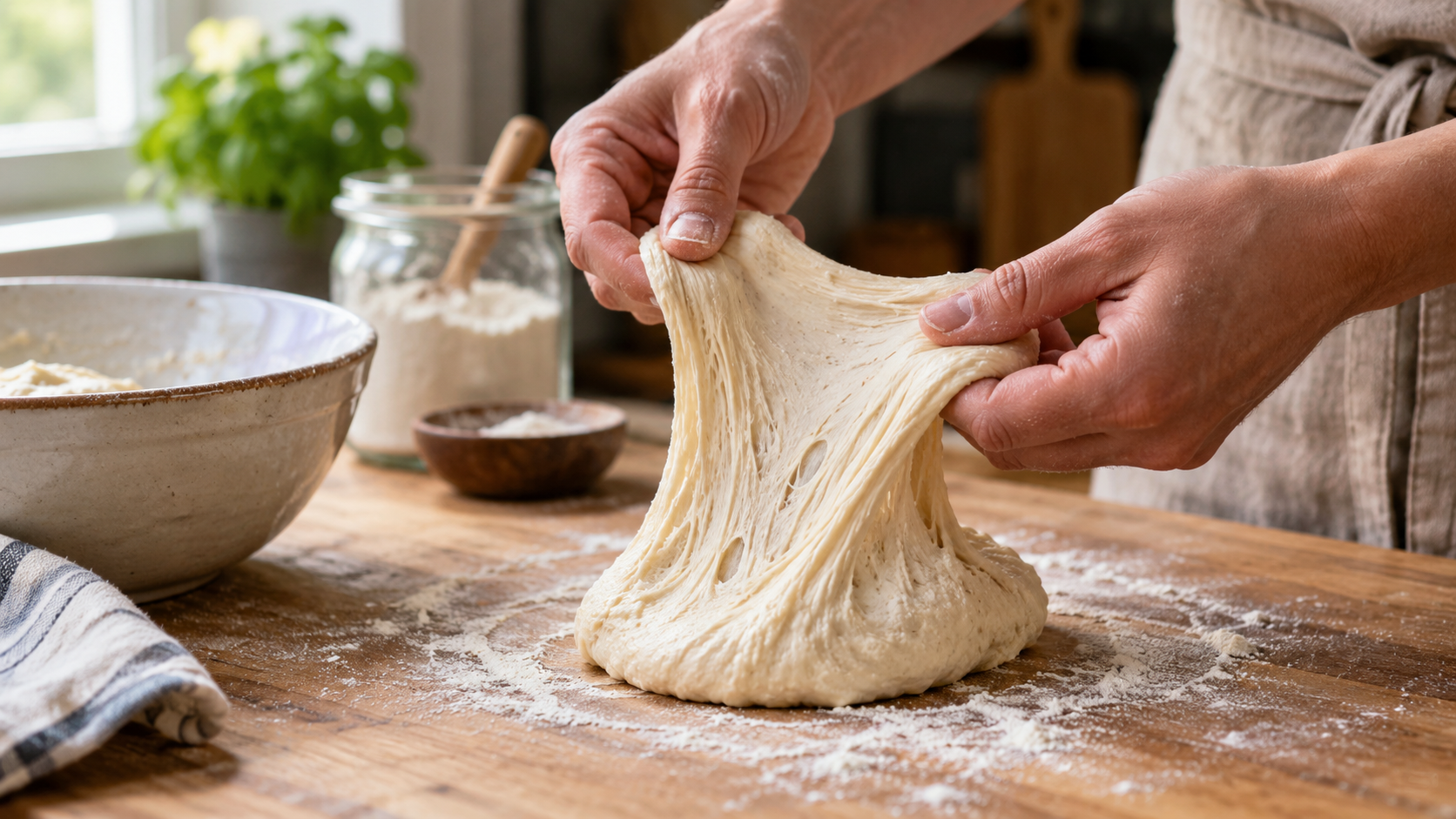
The wall around each growing cell must stretch in two directions. It needs enough give to expand and enough resistance not to thin to a fatal weak spot. In experiments on two wheat flours, Baninder Sroan and colleagues found that the dough with a stronger tendency to strain harden—to resist more as it was stretched—also gave the higher test-bake loaf volume. By changing the molecular-weight distribution of flour protein fractions, they found an optimum rather than a simple “stronger is always better” line. A network too resistant to movement can limit expansion, while a weak one can fail before a useful volume is reached.
Earlier strain-hardening experiments by T. van Vliet and colleagues make the same mechanical problem easier to picture. When a thin region of dough stretches faster than its neighbours, increased local resistance can direct further expansion toward thicker regions instead of letting the thin place rupture. Their preliminary tests compared doughs with poor and satisfactory baking performance. Strain hardening was proposed as a useful criterion, not as one number that fully predicts every loaf from every flour.
The thin layer at the edge of a cell
The familiar picture of gas trapped by a stretchy gluten net is useful, but incomplete. Starch granules and water are part of the cell wall, and the wall can become very thin as proofing continues. Sroan's team found evidence that a liquid film on the inner side of the gluten-starch matrix helps stabilize cells where the surrounding matrix develops gaps late in proofing and early in baking. The film may postpone bubbles joining or breaking. The researchers varied natural flour lipids and protein fractions; their findings supported a two-part stabilization mechanism rather than a single elastic membrane doing all the work.
The liquid interface is not a magic coating, either. In experiments on dough liquor, C. Primo Martin and colleagues measured how proteins, lipids, enzymes and an emulsifier behaved at the air-water boundary, then related those changes to baking tests. Changes in surface properties alone did not account for the larger loaves they observed. Both the material around a bubble and the film at its edge matter. A recipe ingredient may change one without solving the other.
This also explains why proofing is a period of increasing vulnerability. Cells grow, walls thin, and the gas occupies a larger share of the dough. A loaf does not have a universal minute at which it suddenly becomes “overproofed.” Its margin depends on flour, mixing, hydration, temperature, yeast activity and the handling it has already received. The laboratory studies isolate pieces of that problem; none supplies a single clock reading for every home dough. What they do support is looking at the dough's continuing ability to hold its shape, alongside its volume, rather than waiting for maximum height alone.
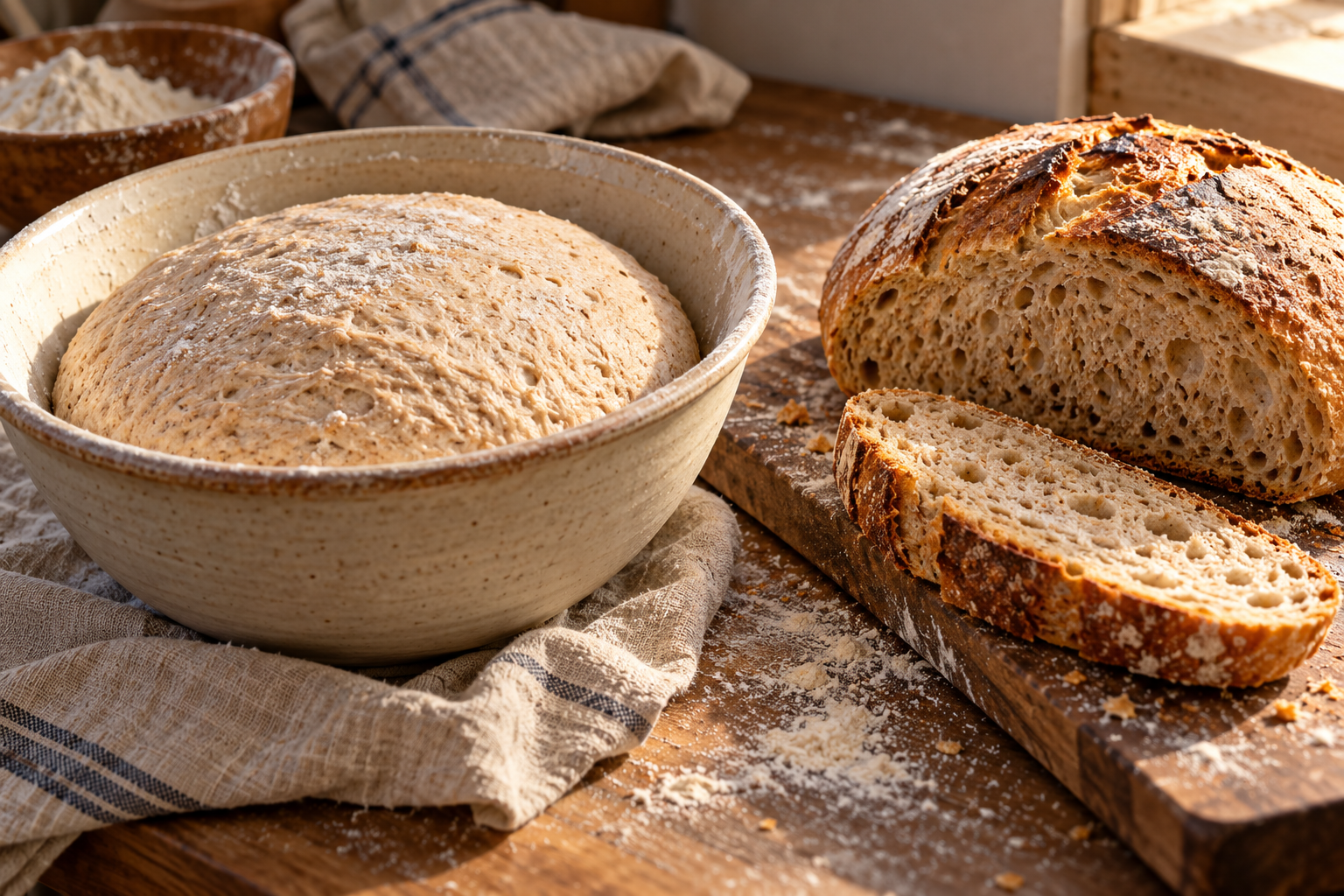
The oven gives the cells one more period of expansion before heat changes the dough into bread. By then, the loaf has inherited all the decisions made on the bench: the pockets mixed in, the carbon dioxide generated, the walls stretched during proofing and the gas already lost. Baking can enlarge a sound structure. It cannot restore a vanished population of small, well-held bubbles. The airy slice on the board begins with gas the dough managed to keep while it was still soft enough to let it go.

A thought worth keeping?